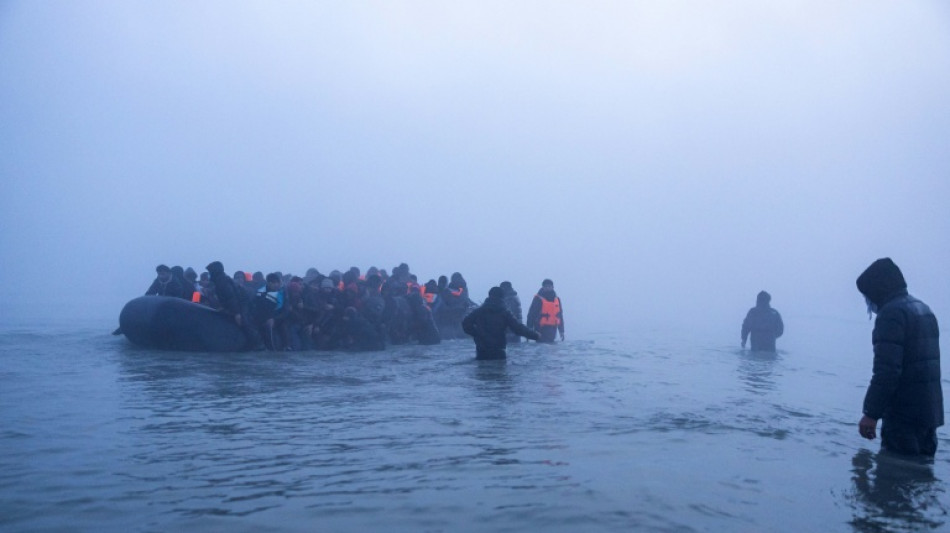
'Lost': Migrants despair after Britain expels them back to France / Photo: © AFP

Former Afghan soldier Haidary Hamedullah risked his life to cross the Channel hoping for a brighter future for his family in Britain, but just weeks later UK authorities expelled him back to France.
"People like me have nowhere in the world to live in safety," said the 28-year-old with chubby cheeks and jet-black hair, whose wife and two children -- who turn eight and 10 this year -- await in Pakistan.
"Where should we go?"
He is one of 1,087 people who the United Kingdom has forcibly returned to France, as part of a so-called "one in, one out" deal with France.
Under the treaty, which came into force on August 6 last year and has been extended to the end of September, the UK can reject migrants who crossed the Channel illegally if they are deemed ineligible for asylum.
In return, London accepts an equal number of migrants from France who have not taken the small boat route.
By the end of June, London had in exchange for its forced removals admitted 1,117 other migrants who had requested entry in France.
London and Paris say the accord helps crack down on people smuggling and limits the number of migrants attempting the often deadly crossing to England's south coast.
More than 41,000 migrants landed last year -- the second-highest annual number since records began in 2018.
But more than 20 charities in both countries have said the French-British deal inflicts "further harm on people who have already survived war, torture, persecution, violence, human trafficking, and a treacherous sea journey".
- 'We ate, waited' -
Hamedullah, who spoke to AFP in Paris, said he was forced to flee Afghanistan to neighbouring Pakistan with his family after the Taliban seized power in August 2021.
Departing alone from Pakistan, he tried a dozen times to cross into Europe via Greece then Bulgaria before succeeding.
He was twice refused asylum in Austria after police stopped him there in June 2022.
Once he had exhausted all means of appeal in February for his EU request for protection, he decided to try his luck outside the bloc -- by crossing the Channel from France to the UK.
He paid 1,500 euros ($1,700) to people smugglers in the French port city of Dunkirk to cross one of the world's busiest shipping lanes to England on a dinghy.
French police thwarted a first attempt.
But in April, after eight hours of lying in wait on the beach then standing in the water, he and others boarded a small vessel unspotted, and headed across the sea.
When they landed in the British town of Dover, officials sent women and children to hotels, but arrested men travelling alone like him.
"Authorities who interviewed me told me that I 'shouldn't be here'," he said.
He ended up with around 350 other people at a detention centre near Heathrow airport outside London.
"We were all depressed," he said.
"We ate, waited, doing nothing." He said there was "only one television with one channel".
Hamedullah said he was assigned a lawyer, with whom he spoke for 30 minutes.
But 51 days later, he was flown back to France, where he now fears he could soon be sent back to Austria.
He said he hadn't committed any crime.
"I fought with your armies," he said, referring to the Western armies that battled the Taliban.
"I'm lost, completely lost."
- 'Feel like an object' -
Yemeni brothers Yunes, 33, and Yassin, 24, say they fled Houthi rebels in 2023, after they overran their country's capital eight years earlier.
Yunes said the siblings, who both have a genetic eye condition and asked not to use their family name for fear of reprisals, spent 18 months in Egypt before travelling to Europe.
He said they received death threats from drug dealers after they arrived in France, and decided to instead cross the Channel to be reunited with their sister, who has British nationality.
At first, when their boat of some 60 passengers landed in April after 15 hours on the water, they were taken to a reception centre and given cake and orange juice.
Then they were questioned.
"The employee of the interior ministry told me I was a criminal and I came illegally," he said.
"I told her I tried to ask for a visa but I never succeeded, and I didn't have any other choice."
Their sister's best efforts to help them failed, he said, and after several weeks' detention, they were sent back to France on a plane in late May.
"I'm so sad," he told AFP via telephone from a refugee shelter in central France, where they are now waiting to hear if they can stay.
"I feel like an object."
(L.Garnier--LPdF)