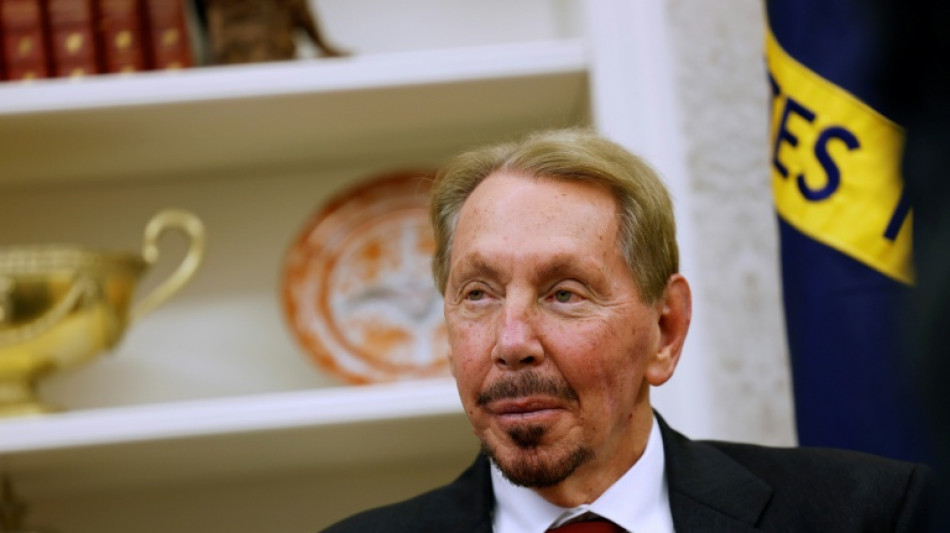
Volatile Oracle shares a proxy for Wall Street's AI jitters / Photo: © GETTY IMAGES NORTH AMERICA/AFP/File

For a reading of Wall Street's shifting mood on the artificial intelligence investment boom, take a look at the daily fluctuations of Oracle stock, analysts say.
Shares of the software giant slumped more than five percent Wednesday following a news report of financing troubles with one of the company's giant AI projects.
But they recovered on Thursday and finished up around one percent at $180.03 as tech companies rallied following blowout results from Micron Technology, another big AI player.
"Oracle is probably the poster child" for the AI investment boom, said B. Riley Wealth Management's Art Hogan, who points to questions about "circular financing" arrangements that have made Oracle and OpenAI dependent on each other for billions of dollars in business.
On Thursday, Oracle -- along with Silver Lake and Abu Dhabi-based MGX -- was also named in a new deal with TikTok, according to an internal memo seen by AFP from the social media company's CEO Shou Chew.
"The US joint venture will be responsible for US data protection, algorithm security, content moderation, and software assurance," Chew said in the memo. The deal would allow TikTok to maintain US operations and avoid a ban threat over its Chinese ownership.
Oracle stock rose more than five percent to $190.81 in after-hours trading on Thursday.
The firm's stock peaked at $345.72 in September after it unveiled a massive inventory of AI work, a surge that briefly vaulted co-founder Larry Ellison above Tesla CEO Elon Musk as the world's wealthiest person.
But its shares have since fallen more than 45 percent as investors have begun to question the risk of AI infrastructure overbuilding and scrutinized the financing of individual projects.
Ellison, a close ally of President Donald Trump, is currently fifth on the Forbes real-time billionaire list with $230 billion.
- Michigan project 'limbo' -
This week's gyrations in Oracle shares followed a Financial Times story Wednesday that described a $10 billion AI data center project in Michigan as "in limbo" after a key partner declined to join the project.
The company, Blue Owl Capital, a backer of other major Oracle projects, pulled back after other lenders pushed for stricter terms "amid shifting market sentiment around enormous AI spending," said the FT, which cited people familiar with the matter.
Oracle, which is taking on billions of dollars of debt in the building spree, described the FT story as "incorrect."
"Our development partner, Related Digital, selected the best equity partner from a competitive group of options, which in this instance was not Blue Owl," said Oracle spokesperson Michael Egbert.
"Final negotiations for their equity deal are moving forward on schedule and according to plan."
OpenAI CEO Sam Altman has said the Chat GPT-maker has committed to some $1.4 trillion in investments in AI computing, with some $300 billion reportedly going to Oracle.
But AI stocks have been volatile in recent weeks as the market scrutinizes the profit outlook for the data centers.
"Investors are starting to ask questions about the sustainability of the AI trade and the profitability," said Steve Sosnick of Interactive Brokers.
The enthusiasm for AI "makes sense" when considering that manufacturing and services companies could see profits enhanced by the technology, Sosnick said, before pointing to doubts over lofty AI equity valuations.
Oracle's price drop on Wednesday followed a selloff last week after the firm's quarterly results sparked worry over its massive capital spending.
Analysts bullish on the stock have emphasized its huge growth potential with the AI boom.
On Thursday, Morningstar trimmed its price target on Oracle to $277 from $286, pointing to greater uncertainty around the projects.
Oracle's elevated debt "leaves little room for error, meaning the new data centers have to generate cash flow as soon as possible to service debt and lease obligations," Morningstar said in a note.
"However, we view recent events, including delays in some data centers' completion dates, as minor setbacks that should not alter Oracle's overall capacity ramp-up."
(M.LaRue--LPdF)