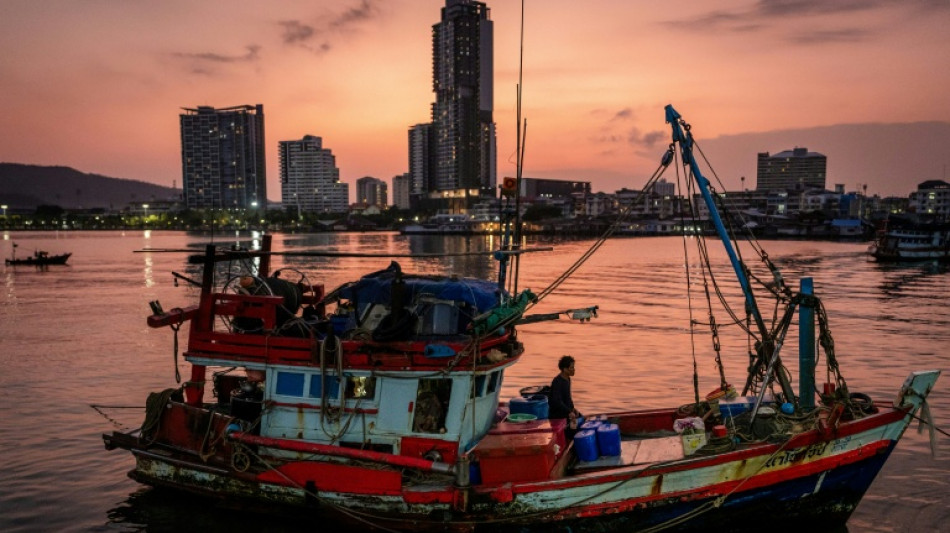
Troubled waters: Thai fishermen marooned by rising fuel costs / Photo: © AFP

With his belongings stuffed into a plastic bag, Thai fisherman Narongsak Kongsuk heads home, far from the sea.
Like hundreds of other fishers in Thailand, his boat is stuck at the dock because of surging diesel prices, as the war in the Middle East disrupts global supply.
The 27-year-old father normally earns up to 20,000 baht ($615) a month, but locked on land, Narongsak fears he will no longer be able to provide for his family.
"There's the cost of my child's milk, various other expenses and car payments," he told AFP on Wednesday.
"I'll have to find part-time jobs."
His boss, Kwanchai Phatisena, has reluctantly decided to leave his boat moored for at least two weeks at the Sriracha jetty, north of the Thai resort city of Pattaya, where egrets and stray cats compete for fish that have fallen from plastic tubs.
"I've been doing this for about 50 years and I've never encountered a situation like this before," said Kwanchai, who is in his sixties.
The boat owner said he was no longer covering his costs due to the rise in the price of diesel, his main expense.
– Tax-exempt diesel –
Fishers in Thailand benefit from tax-exempt diesel, known as "green oil", which cost less than 20 baht per litre before the war in the Middle East broke out on February 28. It now costs 35 baht and is increasingly hard to find.
"There's no profit. It's straight-up losses," said Kwanchai, who has been forced to send his employees home while waiting for prices to fall.
As the sun began to rise behind the buildings lining the beach on Wednesday, several boats made their way back from a night of fishing.
"Those still going out are using the cheaper 'green oil' left over in the tanks. Once this batch is gone, everyone will probably dock because we can't handle the costs," Kwanchai predicted.
The National Fisheries Association of Thailand estimated more than 1,000 boats have already been forced to stay in port, and half the fleet of around 9,000 vessels could soon be idled if the situation drags on.
The association's leaders met with the government in the capital Bangkok on Wednesday to ask in particular that the price of the diesel reserved for fishers be capped, as it is for the general public at the pump.
In neighbouring Cambodia's coastal Preah Sihanouk province, around a third of approximately 1,000 fishing boats have also stopped going to sea due to higher fuel prices, according to Em Phea, director of the provincial fisheries administration.
"They cannot make a profit," he said, adding that some fishermen were still working thanks to fuel stockpiles.
"For now we still have enough seafood, but we don't know yet what will happen in the near future."
And in Vietnam's Quang Tri province, fisherman Nguyen Tri said he was still deciding whether "to sail or not" -- considering the price of diesel for a fishing trip had risen from around $2,300 to $3,800, and it was uncertain whether he could earn enough to cover costs.
– Chain reaction –
Back in Sriracha, another Thai boat owner, 61-year-old Jariya Charuenpunson, fears a chain reaction across the industry if fishers are forced to remain in port for an extended period.
"Every related profession will lose their jobs, leading to even more widespread unemployment," she said.
At the dimly lit town market, a few hundred metres from the jetty, the stalls are still well stocked with fish, shrimp and blue crabs.
But the number of customers have yet to return to pre-Covid numbers, and the current uncertainty adds to the gloomy mood among shopkeepers.
Deboning a small yellowstripe scad, 67-year-old vendor Malida Chaiyakul said supply chains were at risk.
"If all the boats stop, then there's obviously no product to sell."
burs-wjt-sdu/sco/mjw
(A.Laurent--LPdF)