Palestinian Women Transform Organic Loofah Farming into Global Export Industry

A collective of Palestinian women in the West Bank village of Jalameh is revitalizing a traditional agricultural practice by producing organic loofahs for global markets. Supported by technical aid and industrial machinery, the Jalameh Women’s Center Association has transformed the craft into a sustainable export industry that reaches customers in Europe and the Gulf.
In the agricultural fields of Jalameh, a small village north of Jenin in the West Bank, a group of Palestinian women are converting a traditional farming practice into a commercial export industry. For these producers, cultivating organic loofah is both a continuation of generational knowledge and a mechanism for economic independence in an area facing significant financial strain.
The Jalameh Women’s Center Association has led this initiative since 2010, expanding production from a localized domestic craft to an industrialized operation capable of meeting international retail standards. Wasfiyya Shaaban, the association's secretary, stated that the project began with the goal of reviving organic loofah cultivation, which Palestinian women had utilized decades prior, and adapting it for contemporary market demands.
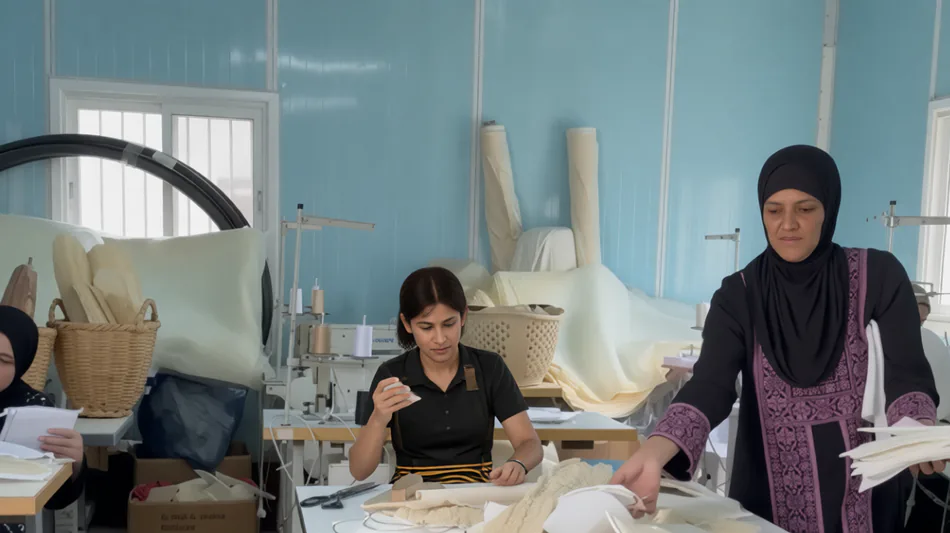
The transition from artisanal work to industrial scale presented substantial technical challenges. Initially, the group attempted to process the dried plant material using standard textile sewing machines, which frequently jammed or broke due to the fibrous texture of the loofahs. The operation achieved a breakthrough through technical intervention by the Applied Research Institute – Jerusalem (ARIJ). ARIJ provided specialized heavy-duty industrial machinery and intensive production training, enabling the collective to produce high-quality goods.
The association now manages a complete vertical supply chain within Jenin. The women oversee every stage of the process, including planting seeds, harvesting mature gourds, sun-drying, peeling, pressing, cutting, and stitching the final organic sponges. To ensure the products remain biodegradable and gentle on the skin, the collective uses 100 percent natural cotton backing.
While the enterprise currently sustains eight full-time female workers and their families, its marketing reach extends well beyond local boundaries. Through participation in foreign trade expos and visits from international delegations to Jenin, Jalameh loofahs have entered European markets, including the Netherlands, Poland, and Germany, as well as Gulf markets such as Saudi Arabia, Kuwait, and Qatar.
The collective faces competition from mass imports, particularly Egyptian loofahs. Shaaban described the path to achieving their current quality standards as a grueling journey of trial and error. She noted that the success of the project demonstrates how cultural heritage can be leveraged to safeguard future livelihoods.
(L.Garnier--LPdF)