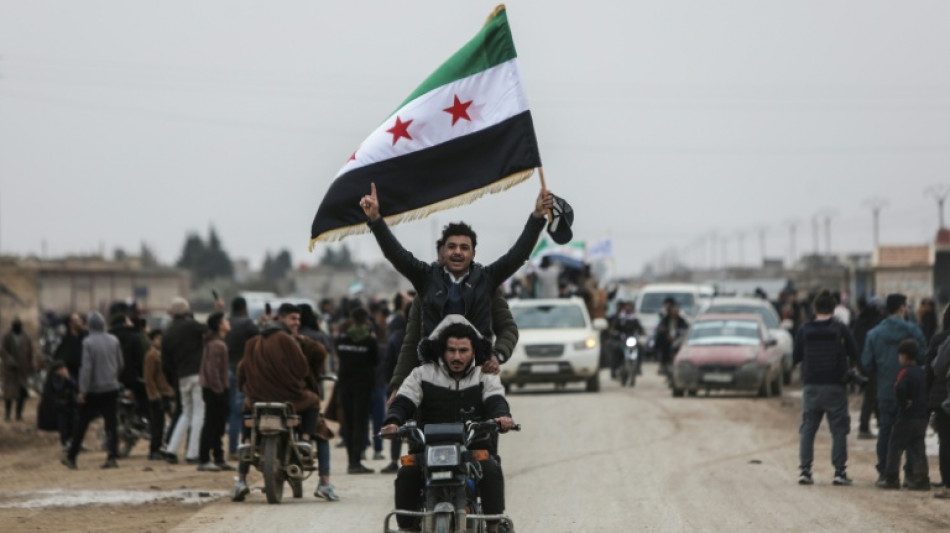
Syria govt forces enter Qamishli under agreement with Kurds / Photo: © AFP

Syrian government forces entered the Kurdish-majority city of Qamishli on Tuesday as part of a deal agreed last week to gradually integrate the Kurds' forces and institutions into the state.
The arrival came after government security personnel entered the mixed Kurdish-Arab city of Hasakeh and the countryside around the Kurdish town of Kobane the day before.
Kurdish forces have ceded swathes of territory to advancing government troops in recent weeks following months of tension and sporadic clashes as Syria's new Islamist authorities have sought to impose their authority across the country.
"A convoy of internal security forces began entering the city of Qamishli," the official SANA news agency said.
An AFP correspondent saw a convoy of vehicles, including armoured personnel, carriers enter the city, which has been the main stronghold of the Kurds' de facto autonomous administration, while forces set up checkpoints at its entrances.
Another correspondent reported few people on the streets inside the city amid a curfew in place until Wednesday morning, with Kurdish security forces also lightly deployed and Kurdish flags and banners raised.
At the city's entrance, interior ministry spokesman Noureddine al-Baba said work would be undertaken to integrate the Kurds' domestic security forces, known as the Asayish, "into the ranks and payroll" of the ministry.
He welcomed Syria's diversity and "all Syrian national personnel" wishing to serve the country.
State television reported that Baba and Marwan al-Ali, the new head of internal security in Hasakeh province, inspected the Asayish security headquarters in Qamishli ahead of its handover.
- 'Gradual integration' -
Friday's deal "seeks to unify Syrian territory", including Kurdish areas, while also maintaining an ongoing ceasefire and introducing the "gradual integration" of Kurdish forces and administrative institutions, according to the text of the agreement.
It was a blow to the Kurds, who had sought to preserve the de facto autonomy they exercised after seizing vast areas of north and northeast Syria in battles against the Islamic State (IS) jihadist group during the civil war.
Mazloum Abdi, head of the Kurdish-led Syrian Democratic Forces (SDF), had previously said the deal would be implemented on the ground from Monday, with both sides to pull forces back from frontline positions in parts of the northeast, and from Kobane in the north.
He added that a "limited internal security force" would enter parts of Hasakeh and Qamishli, but that "no military forces will enter any Kurdish city or town".
On Monday, government security personnel also deployed to the countryside around Kobane, more than 200 kilometres (125 miles) from Hasakeh.
Hemmed in by the Turkish border and Syrian government forces, the town has long been seen as a symbol of Kurdish fighters' victory against IS jihadists.
The United States, which leads a military coalition that had backed the Kurds' campaign against IS, has drawn close to Syria's new Islamist authorities and recently said the purpose of its alliance with the Kurdish forces was largely over.
As state forces deploy to Kurdish-held areas, only Druze-majority Sweida province in the country's south will remain effectively outside government control.
(F.Bonnet--LPdF)