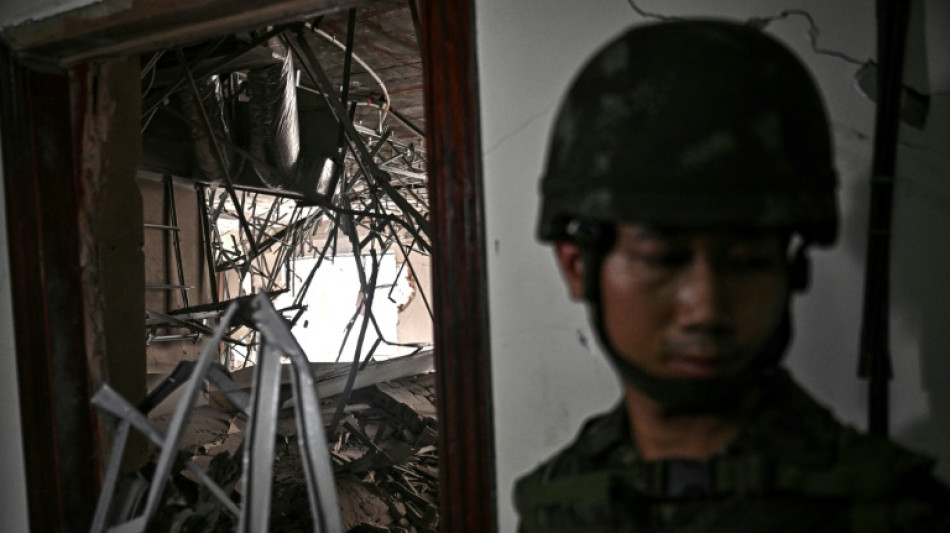
Behind Cambodian border casino, Thai military shows off a scam hub / Photo: © AFP

Broken computer monitors in bombed-out offices, scattered fake police uniforms and phoney hundred-dollar bills: these were the vestiges of a frantic escape of suspected cyberscammers fleeing a resort on the Cambodia-Thailand border.
Southeast Asia has become the epicentre of the multibillion-dollar online scam industry in which hundreds of thousands of fraudsters -- some trafficked, others willing workers -- cheat internet users globally with romance and cryptocurrency investment schemes.
On Thursday, AFP was invited on a Thai military-organised tour of an area of Cambodia's O'Smach which Thai forces captured during border clashes last year.
Thailand says the area had been used as a base of operations by the Cambodian military as well as criminals running transnational scams.
The neighbouring nations engaged in deadly clashes along their disputed frontier for three weeks in December, the latest flare-up in a long-standing border conflict.
Thailand said that month its forces struck several casinos across the border, alleging they were being used as Cambodian weapons storage facilities and firing positions. At least two have been identified by monitors as fronts operating as scam hubs.
"It's by coincidence -- the attack on these facilities was because they were used as military bases by the Cambodian forces," Thai defence ministry spokesman Surasant Kongsiri told reporters on the tour.
When Thai troops advanced their positions, aiming to neutralise the threat from the Cambodian side, they "discovered that the facilities behind the casinos turned out to be scam centres", he said.
Since a fragile truce was agreed in late December, the Thai military has maintained its presence in the area -- despite repeated calls by Cambodia for Thailand to remove its forces from O'Smach and other border zones that were previously controlled by Cambodia.
Cambodian Information Minister Neth Pheaktra accused Thailand of attempting to justify its "de facto annexation" of Cambodian territory "under the pretext of anti-scam operations".
"Such actions represent a dangerous misuse of law enforcement narratives to justify military encroachment," he said in a statement to AFP on Thursday.
- Scammer scripts, call lists -
The destruction and debris remaining in O'Smach more than two months after the fighting ended indicated a rushed flight by thousands of people.
Journalists were led through offices and bunk-bed-filled dormitories where the tools of the scam trade were left behind: fake Australian, Canadian and Indian law enforcement office backdrops, scam call scripts and stacks of paper with phone numbers of targets from around the world.
The Thai military said around 20,000 alleged scammers who were living there escaped just before the missiles hit.
O'Smach and other casino sites Thailand targeted during the December fighting had potentially thousands of victims of human trafficking inside, an analyst told AFP that month.
The sites visited on Thursday -- accommodations for scammers from Vietnam and Indonesia, and offices for Chinese bosses, according to the Thai military -- were opposite the O'Smach resort and casino, owned by Cambodian senator and businessman Ly Yong Phat.
He was sanctioned by Washington in 2024 over his firm's alleged role in "serious human rights abuses related to the treatment of trafficked workers subjected to forced labor in online scam centers", according to US authorities.
Ly Yong Phat in November denied media reports linking him to cybercime and money laundering networks, calling the accusations "fake and damaging to his reputation" in an interview with a Cambodian news outlet.
Prapas Sornchaidee, of the Thai Air Force, said Cambodia -- which has pledged to stamp out scam operations before May -- should cop to their proliferation and elicit international support to combat them.
"If Cambodia were to acknowledge that these (scam) activities are taking place and that they cannot control them, and coordinate with Thailand and other countries so the problem can be addressed, that would be much better."
(O.Agard--LPdF)