Iran says will make US regret war as oil prices soar / Photo: © AFP

Iran vowed Thursday to make the United States regret attacking the Islamic republic and said it would keep up a chokehold on the Strait of Hormuz that has sent oil prices soaring.
The International Energy Agency warned that the Middle East war could lead to "the largest supply disruption" in oil industry history, but US President Donald Trump wrote on social media that defeating Iran's "evil empire" was more important than crude prices.
Trump has faced intense political pressure as the global economic fallout of the crisis has mounted, and he has given mixed messages as to when the US campaign might end.
"While starting a war is easy, it cannot be won with a few tweets. We will not relent until making you sorry for this grave miscalculation," Iranian security chief Ali Larijani said on X.
His comments came after Iran's new supreme leader, Mojtaba Khamenei, issued a defiant statement -- his first since being appointed last Sunday after the death of his father and predecessor Ali Khamenei in a strike.
Mojtaba Khamenei, who was reportedly wounded, has yet to appear publicly since his nomination, and his message calling for vengeance was read by an anchor on state television.
"The lever of blocking the Strait of Hormuz must definitely be used," Khamenei said of the waterway through which a fourth of the world's seaborne oil trade usually transits.
The strait, which also normally accounts for a fifth of the world's liquefied natural gas (LNG) supplies, lies off Iran and is just 54 kilometres (34 miles) wide at its narrowest point.
- 'War of attrition' -
Israeli Prime Minister Benjamin Netanyahu said the joint US-Israeli campaign was "crushing" Iran and the Tehran-backed militant group Hezbollah in Lebanon.
Speaking in a televised media briefing, he added that the war on Iran was intended "to create, for the Iranian people, the conditions to bring down this regime", in addition to hobbling its nuclear and missile programmes.
In an interview with AFP, Iran's deputy foreign minister Majid Takht-Ravanchi said Tehran was acting only in "self defence" and wanted to ensure that war could not be "imposed" on it again.
Takht-Ravanchi confirmed that Iran had been approached by some "friendly countries" to put an end to the conflict, without specifying which ones.
"We are telling them the same thing, that we want the ceasefire to be part of an overall formula for ending the war altogether," he added.
- Fuel tanks, airport hit -
Gulf states have borne the brunt of retaliatory attacks from Iran, which said Thursday that it would "set the region's oil and gas on fire" if its own energy infrastructure and ports were attacked.
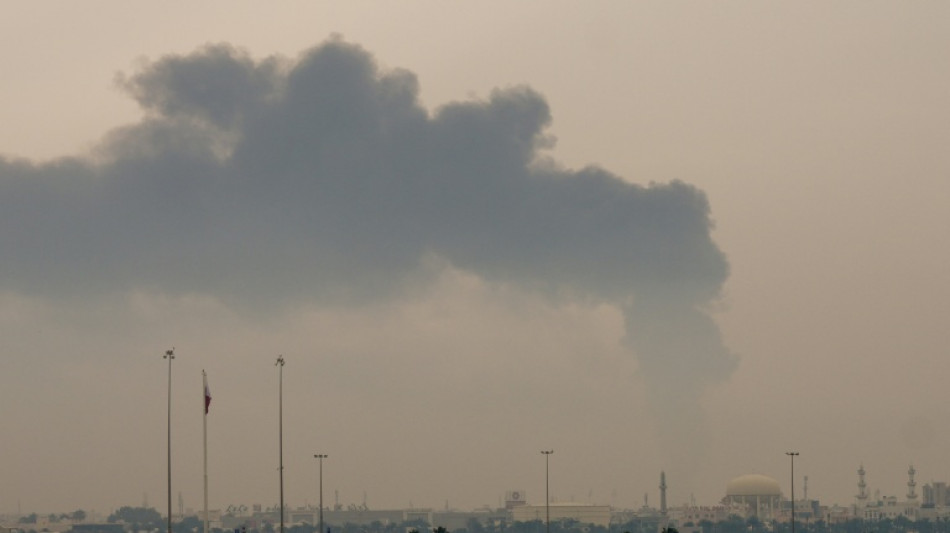
Images from Bahrain on Thursday showed thick smoke rising after a strike on fuel tanks in Muharraq, with residents told to stay inside and close their windows.
Drones caused damage again at Kuwait's international airport and in downtown Dubai, while Saudi Arabia said it had intercepted drones headed towards its Shaybah oil field and its embassy district.
With Gulf states slashing production and oil tankers stuck in the Gulf, benchmark oil prices have risen 40 to 50 percent since the US and Israel attacked Iran on February 28, threatening to crimp growth and stoke inflation.
- 'Extremely tense' -
The war has upended daily life for Iranians.
A 30-year-old woman living in Kermanshah in western Iran said 90 percent of shops in her city had closed.
"People are desperately trying to withdraw their savings from the banks, as trust in them has vanished," she said. "Bread is now rationed. The population is extremely tense and outraged."
The conflict has also spread to Lebanon, where authorities reported 687 people killed by Israeli attacks, including at least 12 who died in a strike Thursday on Beirut's blood-stained seafront, where displaced families were camping in tents.
Israel's military said Hezbollah had launched a barrage of 200 rockets and drones on Wednesday night in "a simultaneous attack with Iran".
Israeli Defence Minister Israel Katz said Thursday that he was ordering troops to "prepare for expanding" attacks on Lebanon, and Israeli forces pushed further into southern Lebanon.
Israel also launched a new broad wave of strikes in Tehran, saying it had struck checkpoints of the Basij paramilitary force that has been deployed to suppress protests against the clerical government.
Iran's health ministry said on March 8 that more than 1,200 people have been killed in the war, a figure AFP has not been able to independently verify.
Three million people have been displaced by the war in Iran, according to figures issued Thursday by the UN's refugee agency, while a UN rights expert said the world had entered a "new dark age of abuses" with US attacks on Iran and Venezuela.
Officials said 14 people had been killed in Israel since the start of the Iran war, while attacks in the Gulf have killed 24, including 11 civilians and seven US military personnel.
burs-wd/js
(V.Castillon--LPdF)