Pakistan announces Eid 'pause' in conflict with Afghanistan / Photo: © AFP

Pakistan announced on Wednesday a "temporary pause" in hostilities with Afghanistan to mark the end of Ramadan, after Kabul promised to avenge the deaths of hundreds killed in a strike on a Kabul drug treatment centre.
The halt in operations for Eid al-Fitr from Thursday to Monday had been requested by "brotherly Islamic countries" Saudi Arabia, Qatar and Turkey, information minister Attaullah Tarar said.
"Pakistan offers this gesture in good faith and in keeping with the Islamic norms," he wrote on X.
But he warned: "In case of any cross-border attack, drone attack or any terrorist incident inside Pakistan, (operations) shall immediately resume with renewed intensity."
There was no immediate response from the Taliban authorities.
On Monday night, Pakistani jets struck a drug rehabilitation centre in the Afghan capital, in the deadliest attack yet in the escalating violence between the two neighbours.
The Taliban authorities have said that around 400 people were killed and more than 200 wounded but the government in Islamabad rejected claims from Kabul of a deliberate strike.
Pakistan accuses Kabul of harbouring extremists behind cross-border attacks on its territory. Afghanistan denies doing so.
- Mass funeral -
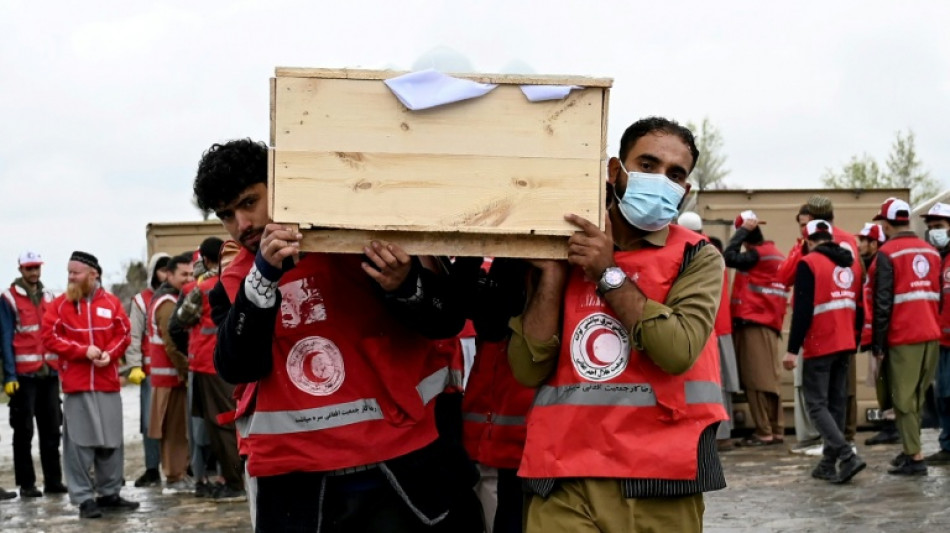
A mass funeral for some of the victims of Monday's strike was held on a rainswept hillside above the Afghan capital earlier on Wednesday afternoon.
Afghan Red Crescent Society volunteers carried dozens of simple wooden coffins from a fleet of ambulances to a mass grave dug in the rocky ground by giant excavators.
At the graveside, Interior Minister Sirajuddin Haqqani said they were innocent victims targeted by "criminals", days before the end of the Muslim holy month.
"We will take revenge," he added and warned those behind Monday night's bombing: "We are not weak and helpless. You will see the consequences of your crimes."
But Haqqani, who until last year had a $10-million US bounty on his head, also suggested that talks were the government's preferred option to halt the fighting.
"We do not want war but the situation has come to this," he said. "So, we are trying to solve the problems through diplomacy."
Interior ministry spokesman Abdul Mateen Qani said the ceremony was for identified victims. Some had been sent back to their home provinces for burial.
Identification of other victims was still ongoing, he added.
Health ministry spokesperson Sharafat Zaman told AFP that 50 coffins had been brought to the Kabul site on Wednesday.
- Identification -
Obtaining immediate independent confirmation of exact death tolls is difficult in Afghanistan and Pakistan, with attacks often in hard-to-reach places and conflicting information.
AFP journalists at the scene on Monday evening and Tuesday morning saw at least 95 bodies extracted from the rubble at the devastated centre.
Jacopo Caridi, the Afghanistan country director for the Norwegian Refugee Council, a humanitarian NGO, said they also had teams on the ground.
"From what we saw and what we discussed with the others involved in the (emergency) response, we can say that there were hundreds of killed and wounded," he told AFP.
Recovery of bodies has proven difficult because of the debris and collapsed structures, and Caridi described the scene as "shocking", which would make identification more difficult.
"I saw a finger in one place, a foot in another place, a hand in one location. It was really horrific," said Caridi.
- Mediation stalled -
Afghanistan and Pakistan have faced calls for an immediate end to the conflict, with the overall civilian death toll mounting and concern about those displaced.
The UN said before Monday's strike that at least 76 Afghan civilians had been killed in the fighting since February 26, and that more than 115,000 families had been forced from their homes.
Mediation efforts, however, have so far proved fruitless.
The focus of Gulf countries, which led early attempts, has shifted to the situation in their own backyard since the start of US-Israeli strikes on Iran last month.
China has sent a special envoy to mediate and pledged to play a "constructive role in de-escalating tensions".
Russia's special representative for Afghanistan, Zamir Kabulov, said Moscow "will be ready" to help broker talks if both sides request it.
"So far, this has not happened," he told pro-Kremlin outlet Izvestia.
(V.Castillon--LPdF)