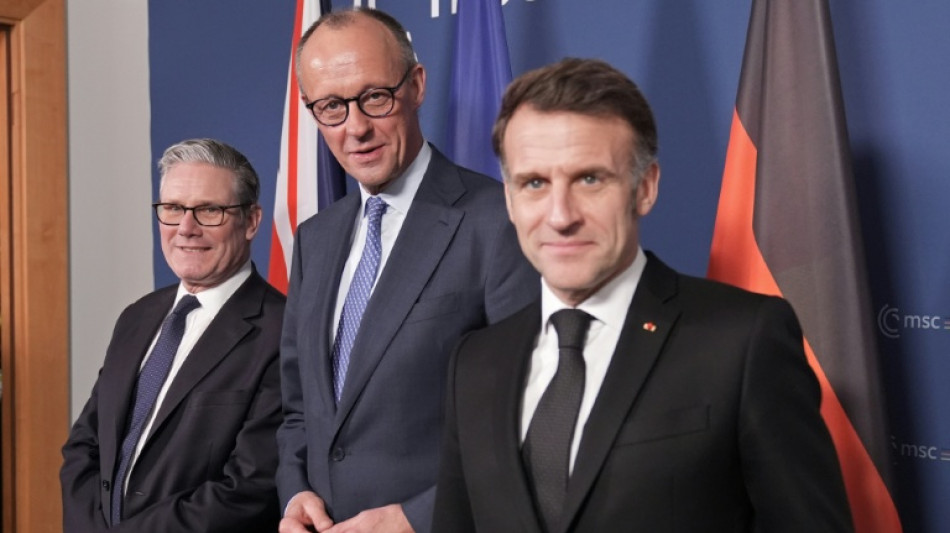
Macron, Starmer rally allies to mull Hormuz mission / Photo: © POOL/AFP

French President Emmanuel Macron and UK Prime Minister Keir Starmer on Friday chair a meeting of allies to consider sending a multinational force to ensure security and free-flowing trade in the Strait of Hormuz once the current conflict between Iran and the US and Israel ends.
Iran imposed the blockade on the critical shipping bottleneck as soon as the US and Israel launched the war against the Islamic republic on February 28, leading to a surge in global energy prices. Even with a shaky ceasefire in place, the US is now imposing its own blockade on Iranian ports.
European leaders are now worried that if the blockade continues, consumers will feel the effects through higher inflation, food shortages and flight cancellations as jet fuel runs out.
The leaders joining Starmer and Macron from 1200 GMT for the meeting -- which will mostly be held via video -- are due to call for a return to full freedom of navigation and address the economic consequences of the blockade.
But they will also "prepare the deployment, when conditions are met, of a strictly defensive multinational military mission, in order to ensure freedom of navigation," according to the invitation sent by the Elysee which was seen by AFP.
Officials have emphasised that such a force would only be deployed when the war came to an end. Macron and Starmer have also led efforts to create a European force to support Ukraine, which again would only be deployed when the war against Russia ends.
Starmer is expected to tell the meeting that "the unconditional and immediate reopening" of the strait "is a global responsibility", his Downing Street office said in a statement.
Starmer is to say both he and Macron have a clear commitment "to establish a multinational initiative to protect freedom of navigation" to reassure commercial shipping and support mine clearance operations, it added.
A French presidential official, asking not to be named, said allies needed to be sure "we have an Iranian commitment not to fire on passing ships and a US commitment not to block any ships leaving or entering the Strait of Hormuz."
- 'Major consequences' -
The meeting, which is set to gather some 30 leaders of European countries but also Asian and Middle Eastern nations mainly by video conference, is also a chance for Europe to display its capacities after having largely been sidelined by the US in diplomatic efforts to end the war.
Key EU players German Chancellor Friedrich Merz and Italian Prime Minister Giorgia Meloni will be attending in person, their offices confirmed.
The talks according to the Elysee will involve "non belligerent countries" meaning that neither Iran, Israel nor the United States will be involved.
"The blockade of the Strait of Hormuz has major consequences for the global economy, and therefore for the daily lives of French citizens and French businesses," France's Foreign Minister Jean-Noel Barrot said on Thursday.
Downing Street said planning is already underway for a "combined military effort as soon as conditions allow". Military chiefs are due to meet next week for further discussions at the UK's military command headquarters in Northwood outside London, it added.
According to the French presidency, the meeting will also address concerns over the more than 20,000 seafarers aboard the hundreds of ships which have been trapped by the blockade.
"What we want to do is build a credible proposal which is essentially a third way between the maximum pressure previously practiced by the United States on Iran and the resumption of war," said the French presidential official.
Merz, whose country was initially reluctant to be involved in any mission for Ukraine, said Berlin was "willing in principle to take part" but cautioned that "we are still very far from that".
He also added the leaders would discuss the involvement of the United States. But the French presidential official said Washington -- as a belligerent power in the conflict -- should not be involved in this mission.
(E.Beaufort--LPdF)