Europe, Canada leaders hold Yerevan talks in Trump's shadow / Photo: © AFP

European leaders and Canadian Prime Minister Mark Carney gather in Armenia Monday as they seek to navigate a fraught geopolitical environment under an unpredictable White House.
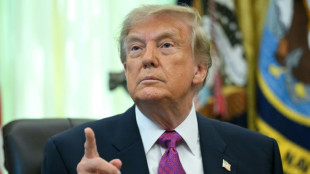
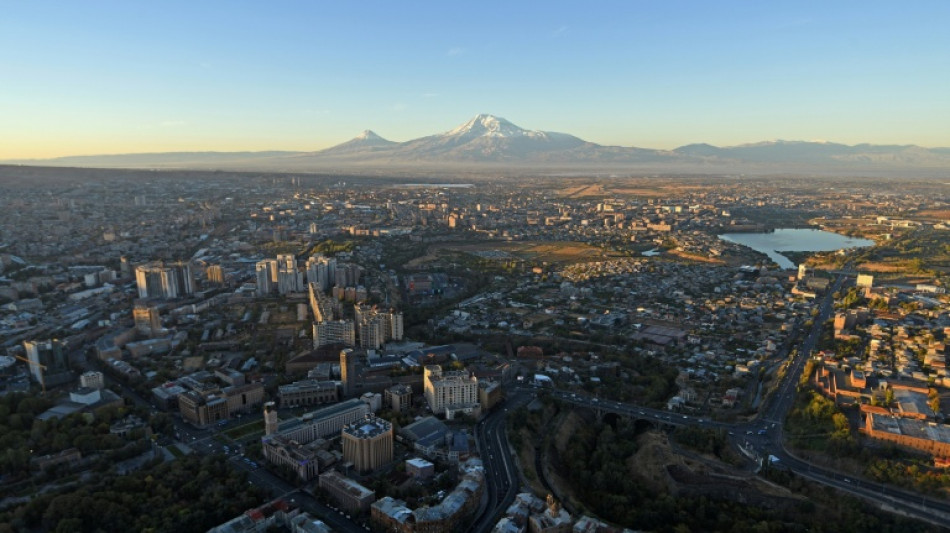
US President Donald Trump will loom large over the meeting of the European Political Community (EPC). It takes place in Yerevan, a crossroads between Russia and the Middle East -- the two main issues on the agenda.
"Leaders from across the continent, with Canada as a guest, will discuss how to cooperate to strengthen security and collective resilience," European Council President Antonio Costa wrote on social media as he arrived in the Armenian capital Sunday.
The Iran war, which has rattled the global economy by sending energy prices soaring, has deepened a rift in transatlantic ties.
Following a spat between Trump and German Chancellor Friedrich Merz, who had criticised Washington's handling of the conflict, the United States announced it would withdraw 5,000 US troops from Germany.
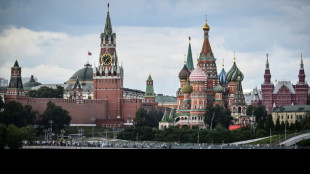
That has added to the doubts surrounding the US commitment to defend its European allies as Russian President Vladimir Putin's war in Ukraine grinds into a fifth year.
Ukraine's President Volodymyr Zelensky and NATO chief Mark Rutte will be present in Yerevan, while Merz will be represented by France's Emmanuel Macron.
They will be joined by Canada's Carney -- the first-ever non-European leader to join the EPC talks, in a sign of the ever-closer ties between Ottawa and Europe ushered in by Trump.
The summit "in a nutshell, will be an opportunity to emphasise that Europe's security is a 360-degree challenge", said a senior EU official.
Like Europe, Canada's economy has been hurt by Trump's tariffs -- but Carney has remained defiant, emerging as something of a figurehead for countries looking to stand up to the Republican president.
In a stirring speech earlier this year, he urged middle powers to join forces in the face of a new global reality defined by great power competition and a "fading" rules‑based order.
"The EPC was initially perceived as an anti-Putin club," said Sebastien Maillard, a special adviser at the Jacques Delors Institute, a think tank.
"With the invitation to Canada, this initiative -- which was initially driven by geography -- is now taking on an anti-Trump slant."
Moving to diversify away from its southern neighbour, Ottawa has joined the EU's defence financing scheme -- the first non-European country to do so -- and sought to increase cooperation on trade.
"Canada has a way of looking at the world and looking at ways to solve the challenges we have currently that Europe shares to a great extent," said the EU official, speaking on condition of anonymity.
- 'Reorientation' -
A biannual political forum, the EPC was established on the initiative of French President Emmanuel Macron in 2022 in response to the invasion of Ukraine.
It brings together the members of the European Union and, this time, 21 other countries, from Albania to Britain.
EPC summits do not normally produce concrete decisions but offer the opportunity for leaders to exchange in groups and bilaterally. Most leaders arrived in the Armenian capital for an informal dinner on Sunday.
Spanish Prime Minister Pedro Sanchez was expected to join the meeting on Monday, Madrid said, after a technical problem with his plane forced him to make an emergency landing in Turkey and spend the night in Ankara.
The Yerevan gathering is the first of its kind in the Caucasus and comes as Armenia fosters closer ties with Europe while seeking to cautiously loosen itself from Russia's grasp.
It will be followed Tuesday by an EU-Armenia summit with the bloc's chief officials Costa and European Commission chief Ursula von der Leyen, who described it as a "major milestone" in the country's rapprochement with Europe.
Relations between Yerevan and its traditional ally Moscow have become strained in recent years, in part because Russian peacekeepers failed to intervene during military conflicts with neighbouring Azerbaijan.
Under Prime Minister Nikol Pashinyan, Armenia has formally pursued a strategy of what he calls "diversification", in which the landlocked country pursues ties with both Russia and the West.
Costa says the bloc looks forward to "deepening this relationship" with the country of three million, which signed a comprehensive partnership agreement with the EU in 2017 and last year declared its intention to apply for membership.
Putin has declared himself "completely calm" about Armenia's overtures to Europe -- while also warning that belonging to both the EU and the Russian-led Eurasian Economic Union was "simply impossible".
(L.Chastain--LPdF)