Europe, Canada pull together in Yerevan in Trump's shadow / Photo: © AFP

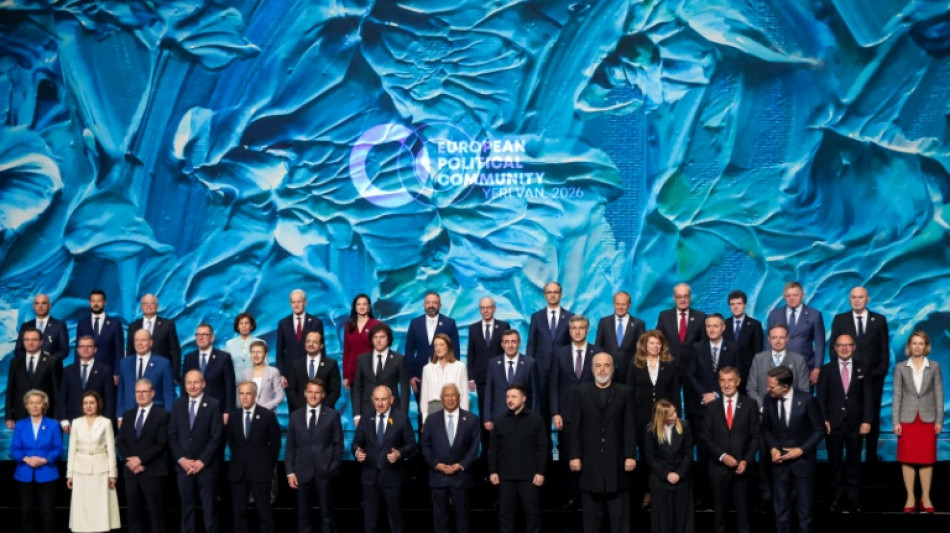
European leaders talked up independence on defence and closer ties with Canada Monday, as they gathered in Armenia for a summit clouded by US threats to cut military support.
US President Donald Trump loomed large over the meeting of the European Political Community (EPC) in Yerevan, which was for the first time attended by a non-European leader: Canada's Mark Carney.
"We don't think that we're destined to submit to a more transactional insular and brutal world and gatherings such as these point to a better way forward," the Canadian prime minister told fellow leaders.
Trump's go-it-alone policies on trade and defence have pushed Canada and Europe closer together, with both now confronting the economic fallout from the US-Israeli war on Iran which has further strained transatlantic ties.
The Armenia gathering comes days after Washington announced it would pull 5,000 US troops from Germany, whose leader, Chancellor Friedrich Merz, has sparred with Trump over the Middle East conflict.
"We have to step up our military capabilities to be able to defend and protect ourselves," EU chief Ursula von der Leyen told reporters in Yerevan. The bloc needed "more independence" in security matters, she added.
Like Europe, Canada's economy has been hurt by Trump's tariffs -- but Carney has remained defiant, emerging as something of a figurehead for countries looking to stand up to the Republican president.
He has urged middle powers to join forces in the face of a new reality defined by great power competition and a "fading" rules‑based order.
Moving to diversify away from its southern neighbour, Ottawa has become the first non-European country to join the EU's defence financing scheme, while seeking to increase cooperation on trade.
"We're the most European of non-European countries, so there's many ways that we can work together," Carney told reporters in Yerevan.
"Great to count on friends like Canada!" European Council President Antonio Costa wrote on social media.
A biannual political forum, the EPC was established on the initiative of French President Emmanuel Macron in 2022 in response to the invasion of Ukraine.
It was "initially perceived as an anti-Putin club" but Canada's participation has given it a new "anti-Trump slant", said Sebastien Maillard, a special adviser at the Jacques Delors Institute, a think tank.
- 'Stepping up' -
Trump's threats to reduce the US military presence on the continent have reinforced calls for Europe to do more for its own security, as Russian President Vladimir Putin's war in Ukraine grinds into a fifth year.
"This summer will be a moment when Putin decides what to do next, expand the war or move to diplomacy, and we must push him toward diplomacy," Ukrainian President Volodymyr Zelensky told the gathering, calling for more sanctions on Moscow.
NATO chief Mark Rutte admitted Monday there had "been some disappointment on the US side" over Europe's reluctance to get behind the Iran war.
But Europeans had "heard the message", were now providing logistical support to US operations and pre-positioning "key assets close to theatre, for the next phase", Rutte told reporters.
"Europeans are taking their destiny into their own hands, increasing their defence and security spending, and building their own common solutions," echoed France's Macron.
- Albania to Britain -
The EPC brings together the members of the European Union and, this time, 21 other countries, from Albania to the UK.
EPC summits do not normally produce concrete decisions but offer the opportunity for leaders to exchange in groups and bilaterally.
Azerbaijan's President Ilham Aliyev took part via video link, something an EU official said was "highly significant" and reflected progress in ties with bitter rival Armenia after the signing of a peace deal last year.
The gathering is the first of its kind in the Caucasus and comes as Armenia fosters closer links with Europe while seeking to cautiously loosen itself from Russia's grasp.
It will be followed Tuesday by an EU-Armenia summit with the bloc's chief officials Costa and von der Leyen, who described it as a "major milestone" in the country's rapprochement with Europe.
Under Prime Minister Nikol Pashinyan, Armenia has formally pursued a strategy of what he calls "diversification", in which the landlocked country pursues ties with both Russia and the West.
(L.Chastain--LPdF)